Tankless Water Heater Service in Woodstock, GA
Tankless units are common in the newer, larger homes built around Towne Lake over the last 10 to 15 years, and Georgia's moderately hard water means mineral scale builds up inside the heat exchanger faster here than it would in a soft-water state, which is the single biggest reason a tankless unit underperforms.
Endless Hot Water Heater Not Living Up To The Name Anymore?
If the on-demand or "endless hot water" unit you installed for exactly that reason is now running lukewarm, cutting out mid-shower, or making a popping sound on startup, that is almost always a maintenance issue rather than a failed unit, and it has a name: tankless water heater service, meaning descaling and flushing the internal heat exchanger.
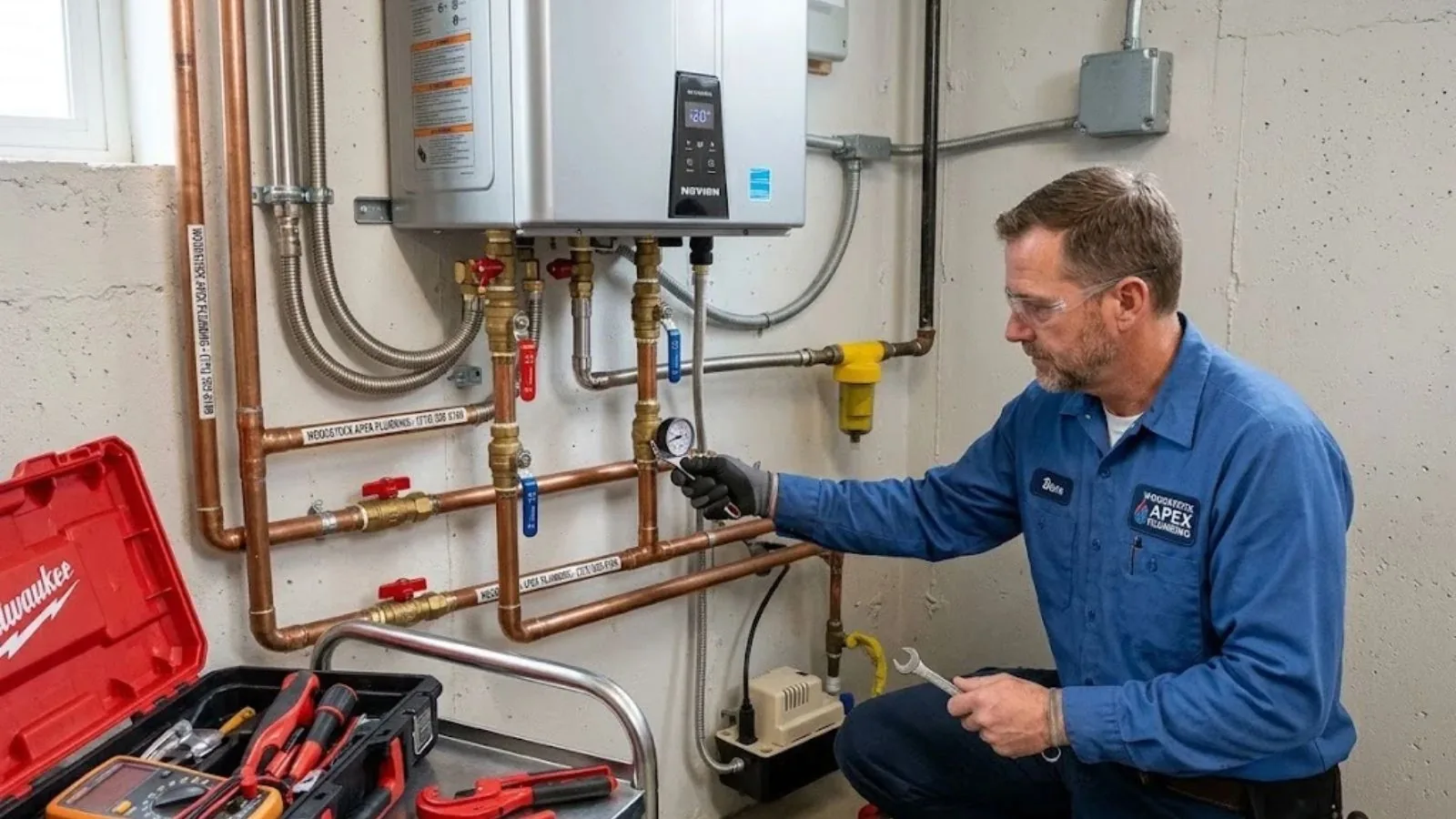
A tankless water heater that has never been descaled will show declining performance gradually: slightly less hot water flow, then temperature that swings instead of holding steady, then eventually an error code or full shutdown as scale restricts the heat exchanger. Manufacturers generally recommend descaling every 12 to 18 months in a hard-water area, and most homeowners never get told that at installation.
The service itself involves flushing the unit with a descaling solution through the isolation valves most tankless units have built in for exactly this purpose. If a unit was installed without isolation valves, which happens more often than it should on a rushed install, adding them is part of bringing the unit up to a serviceable standard.
An error code on a tankless unit's display is usually specific to the manufacturer and points to a real, diagnosable cause, ignition failure, flow sensor issue, or overheating protection, rather than a mystery that requires guessing. We read the actual code rather than resetting the unit and hoping it does not recur.
A tankless unit that is genuinely failing, rather than just scaled up, is still often a repair rather than a full replacement, since the heat exchanger and igniter are individually serviceable parts on most residential units.
Electric tankless units avoid the venting question entirely but draw significantly more amperage than a standard household circuit provides, which means a whole-home electric tankless conversion often requires an electrical panel upgrade. That is worth pricing out before committing to electric over gas tankless, especially in an older home with a smaller original panel.
A tankless unit's minimum flow rate matters more than most homeowners realize: most residential units need a small minimum flow (often around 0.5 gallons per minute) to activate at all, which is why a single slow-trickle fixture, like filling a small cup at the bathroom sink, sometimes will not trigger hot water even though the unit is working correctly.
Sizing a tankless unit correctly the first time matters more than it does with a tank, since an undersized unit will genuinely run out of capacity during simultaneous use (two showers and a dishwasher at once, for example) rather than just running slower. We size a replacement or new installation to the home's real fixture count and typical simultaneous use, not a generic square-footage rule of thumb.
If descaling does not resolve a temperature or flow problem, the next step is usually a targeted repair of the specific failed part rather than a full unit swap.
A tankless unit installed without isolation valves is also more prone to hidden fitting leaks over time, which is a job for leak detection if water shows up somewhere it should not.
Most of our tankless service calls come from the newer construction in and around Towne Lake, where these units are most common.
What It Typically Costs
| Service | Typical Range |
|---|---|
| Descaling & Flush Service | $200 to $350 |
| Isolation Valve Installation (If Missing) | $150 to $300 |
| Heat Exchanger or Igniter Repair | $350 to $750 |
We give a written quote before non-emergency work begins. Emergency dispatch carries a standard trip charge disclosed on the call. Want a real number for your situation? Call (770) 214-4545.
Frequently Asked Questions
How often does a tankless water heater need to be serviced?
Manufacturers generally recommend descaling every 12 to 18 months in an area with moderately hard water like Woodstock, sooner if the unit was never serviced at all after installation.
Why does my tankless water heater's temperature keep fluctuating?
Fluctuating temperature is the classic early sign of mineral scale building up inside the heat exchanger, restricting flow unevenly. It usually resolves with a descaling flush rather than needing a new unit.
Can a tankless water heater be repaired, or do I need a full replacement?
Most tankless failures are repairable. The heat exchanger, igniter, and flow sensor are individually serviceable parts on most residential units, and full replacement is usually only necessary after a very long service life or damage the manufacturer does not support repairing.
24/7 Emergency Dispatch In Woodstock, GA
Whatever the entry point, a burst pipe, no hot water, or a backed-up drain, our dispatch line runs around the clock, every day of the year.